Infectious Disease care doesn't always fit neatly into a staffing model.
Some institutions have recurring ID needs that are too small to justify another full specialist—but too important to leave without dependable access.
Clinical Capacity Stewardship is investigating whether smaller pieces of demand can be combined to support a stable team of Infectious Disease physicians.
Where is specialty capacity?
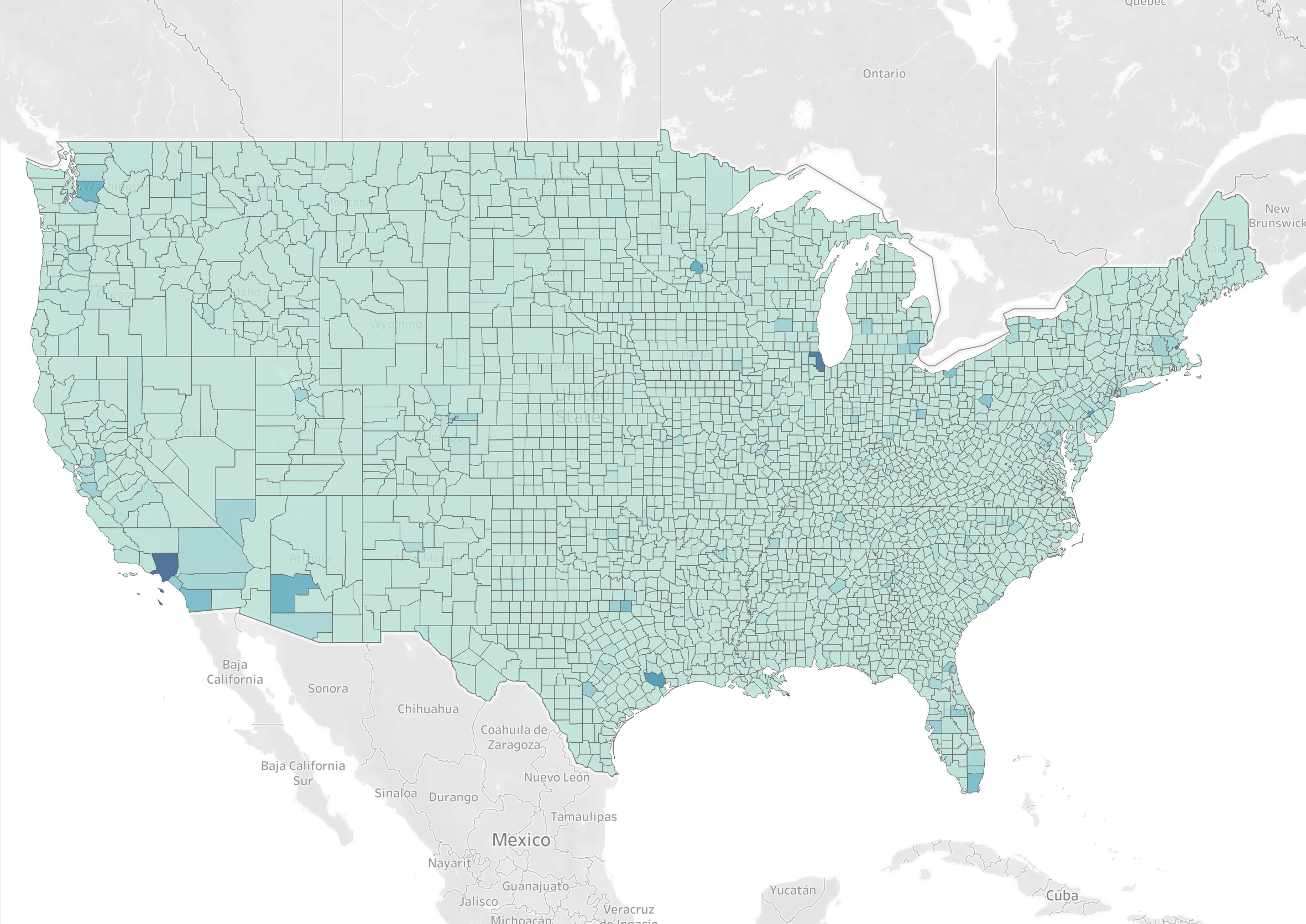
The CCI Specialty Atlas is mapping clinical workforce geography across 3,144 U.S. counties. The project will introduce two specialty layers per week over approximately 30 weeks beginning in 2027.
Workforce location is not the same as usable clinical capacity. Explore the research behind that distinction at the independent nonprofit CCI.
Remote Infectious Disease care is established. The remaining question is fit.
UPMC clinicians have been providing Infectious Disease consultation to hospitals through telemedicine since 2013. The category is no longer experimental.
Hospitals and other institutions already receive Infectious Disease expertise remotely. Existing models have shown that remote physicians can work with local clinical teams, review and document in the EHR, provide consultation and stewardship, and support care without being physically present every day.
So the question is no longer whether remote ID care can work.
CCS begins with what that experience has already established—and asks where the existing models still do not fit.
Where do existing options still not fit the amount of need, the way care is delivered, or the kind of ongoing clinical relationship an institution wants?
Built on an established category
Published work has documented the challenges of sustaining specialty telemedicine in lower-volume settings and the value of pooling demand. Infectious Disease organizations have also supported telemedicine as a means of extending specialist expertise.
What might a better fit look like?
A small, redundant physician team that gets to know the institution over time—its clinicians, workflows, EHR, capabilities, constraints, and escalation pathways.
Familiar enough to build a relationship. Redundant enough not to depend on one physician.
This is a design hypothesis, not a claim of superiority. CCS is investigating whether institutions value this kind of durable clinical familiarity, where it matters, and whether it can be provided sustainably.
How CCS is thinking about the problem
An individual institution may not need enough Infectious Disease care to support another full specialist. Several institutions with compatible needs may collectively support a stable physician team.
CCS is exploring whether those smaller pieces of demand can be assembled into recurring access to a small, redundant ID team with a defined clinical scope and response interval.
The institution can buy the amount of capability it actually needs. The physician should still have a stable, protected commitment rather than a collection of unpredictable gigs.
A protected clinical core, with capabilities that can fit the institution.
The base relationship is intended to provide scheduled and responsive specialist access within a defined scope, response interval, EHR workflow, local-team interface, and escalation path.
Depending on the institution and validated need, additional capabilities may include antimicrobial stewardship, ID pharmacy support, infection prevention, OPAT support, education and case review, after-hours readiness, and agreed clinical and operational reporting.
The objective is not to force every institution into the same service bundle. It is to determine what capability the institution actually needs and whether that capability can be constituted sustainably.
Who might this fit?
CCS is investigating institutions with clinically consequential but fragmented specialty demand.
That may include community and rural hospitals, post-acute and multi-site organizations, institutional populations, and other settings where the amount of specialist need does not fit conventional staffing economics.
Rural institutions remain an important part of this inquiry because recruitment difficulty, thin specialist coverage, transfer dependence, limited economies of scale, and fragile local staffing may make the problem especially visible. But rurality itself is not the defining criterion.
The defining question is whether an institution owns real clinical demand without an economically viable amount of dependable specialist supply.
Tell us what you've tried.
If your institution has tried to secure Infectious Disease coverage—or has a clinically important need that does not fit conventional staffing—we would like to understand the boundary of the problem.
- What have you tried?
- What were you offered?
- What worked—and what did not?
- What was too expensive, cumbersome, intermittent, or impersonal?
- What clinically consequential need remains?
We are especially interested in the practical details: response expectations, continuity, credentialing and activation burden, local staffing requirements, and the amount of recurring demand.
No proposal is necessary. If it is easier, send a short voice memo.
This remains a test.
CCS has not yet established that its model creates greater institutional value, operates with a leaner administrative burden, or provides more continuous or reliable specialist relationships than existing specialty-access models.
Those are questions to be measured—not claims to be assumed. Where institutions are price-sensitive, CCS will examine the economics directly. The larger question is whether a different architecture can create greater institutional value while supporting durable physician relationships.
We are studying where existing arrangements become difficult to sustain, what institutions actually require, and whether fragmented demand can support a protected specialist team with sustainable economics.
Why aggregate fragmented demand?
Because demand can be real without being large.
An individual institution may not need another full specialist. Several institutions with compatible needs may collectively support a stable specialist team.
CCS is investigating whether that aggregation can create something more durable than episodic access: protected clinical capability, institutional familiarity, defined response expectations, and redundancy over time.